Parenting
0 min read
What not to put in a baby’s crib: Safe sleep guide


Cradlewise Staff
When it comes to your baby’s sleep, it’s natural to want their crib to feel cozy, warm, and comforting. A soft blanket, a cute pillow, a favorite stuffed toy, not only look more fun, but also feel instinctively right. But they are safe sleep hazards and create an unsafe sleep environment for your little one.
When it comes to safe sleep, the golden rule is: less is more.
If you’ve been wondering what not to put in a baby’s crib, you have come to the right place. This guide walks you through exactly what to avoid, why it matters, and what to use instead, so your baby can sleep safely, and you can rest a little easier too.
We have to talked to medical experts who have shared their valuable insights which you will find as you read on.
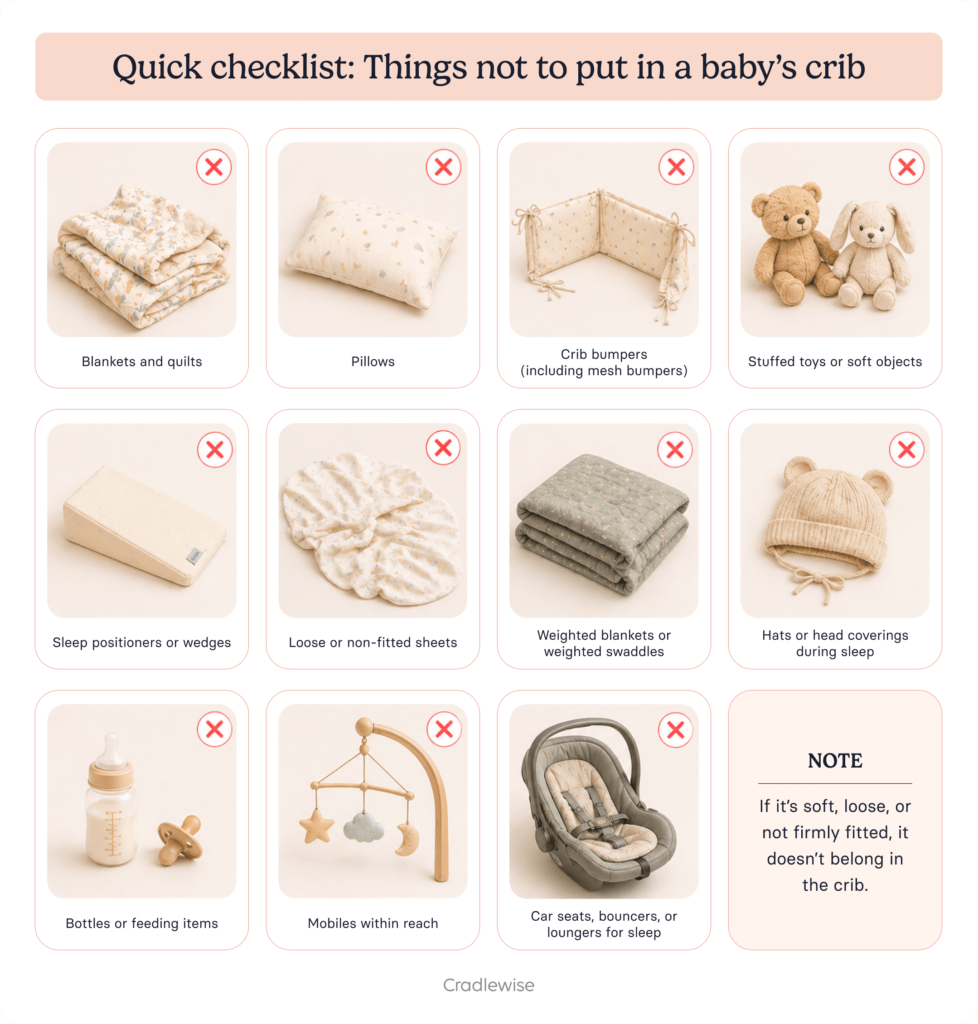
Quick checklist: What not to put in a baby’s crib
Why these items aren’t safe for sleep
As per the Academy of American Pediatrics (AAP), loose items in the crib can increase your baby’s risk of entrapment, suffocation or strangulation. They can:
- Block your baby’s airway and increase the risk of suffocation: Items in the crib can obstruct the flow of fresh air around the baby.
- Contribute to Sudden Infant Death Syndrome (SIDS): Babies may not have the strength or coordination to move these items away from their faces, increasing the risk of accidental suffocation and SIDS.
- Cause overheating, which is a known risk factor for unsafe sleep: Extra items in the crib can contribute to overheating, which is a risk factor for SIDS.
Dr. Anna Cornish, Medical Director, Ambulatory General Pediatrics, Staten Island University Hospital, Northwell Health, says, “Many parents believe that infants need to be kept extra warm and bundled at all times. These factors may raise an infant’s body temperature to levels that interfere with the brain’s ability to control temperatures and breathing, contributing to an increased risk of SIDS.”
- Increase the chance of entrapment or strangulation: Placing soft and loose items, such as pillows or blankets, in the crib increases the risk of the baby rolling into or against these items, which could pose a risk of entrapment and strangulation.
Babies don’t yet have the strength or coordination to move objects away from their face, which is why a clear crib is the safest choice.
Common items to avoid in your baby’s crib
According to the U.S. Consumer Product Safety Commission, “bare is best”. The only thing allowed in a crib or bassinet should be the fitted sheet.
Here’s a list of things to avoid in your baby’s crib:
- Blankets and quilts: Even lightweight blankets can cover your baby’s face during sleep leading to the risk of overheating, entrapment, and suffocation. Instead, opt for a wearable blanket or sleep sack.
- Pillows: Pillows are not safe for infants, as they can obstruct breathing and increase suffocation risk.
- Crib bumpers, including mesh bumpers: While they may look protective, bumpers can pose suffocation and entrapment risks.
- Stuffed toys and soft objects: Soft toys can block airflow if they end up near your baby’s face during sleep.
- Sleep positioners and wedges: These are often marketed for comfort or reflux but are not considered safe for unsupervised sleep.
- Loose or non-fitted sheets: Only use a snug, fitted sheet over the crib mattress. Loose bedding can bunch up and create hazards for your sleeping newborn.
- Weighted blankets or swaddles: Weighted sleep products can restrict movement and breathing, making them unsafe for babies.
- Hats or head coverings: Babies regulate temperature through their head, and covering it can lead to overheating.
Sami Amundsen, RN and Co-founder of Birth Halo, says, “After the delicate newborn stage, using a head covering during sleep is a major modifiable risk factor associated with SIDS.” - Bottles or feeding items: Leaving bottles in the crib can pose choking risks and disrupt safe sleep.
- Mobiles within reach: Mobiles should be removed once your baby can reach them, to prevent entanglement.
- Car seats, bumpers, bouncers, or loungers: These are not designed for routine sleep and can increase the risk of unsafe positioning.
Tips when selecting and setting up your baby’s crib
A baby’s crib setup for safe sleep includes:
- Crib with no drop-side rail: The side rails should not be able to move. Do not use cribs with drop rails.
- Safe bar distance: The distance between crib’s bars must not be more than 2-3/8 inches apart to keep infants from falling out and toddlers from getting their heads trapped between the bars.
- Crib rails height: The crib rails should be at least 26 inches above the mattress support in its lowest position.
- Corner posts: Corner posts should be flush. Avoid corner posts that could cause injury or snag clothing.
- Crib mattress: The mattress should be firm, not sag under your baby’s weight and fit snugly, leaving no space between the mattress and crib sides.
Safe sleep essentials: What your baby actually needs
The AAP recommends the following to reduce the risk of sleep-related deaths:
- Putting your baby on a firm, flat mattress
- Always place your baby on their back
- Avoid letting your baby sleep in swings, loungers, or car seats outside the car
- Breastfeed for the first six months and continue for two years of age
- Keep up to date on vaccines
- Maintain a comfortable room temperature
- Avoid nicotine, alcohol, and recreational drugs
- Supervise awake tummy time
- Share a room, not a bed
- Consider offering a pacifier at sleep time
- Avoid products that claim to reduce the risk of SIDS
- Discontinue swaddling when baby attempts to roll over (usually around 3-4 months)
- Choose a crib that meets current safety standards
Conclusion
It can feel counterintuitive at first to keep your baby’s crib completely empty when every instinct tells you to make it cozy, especially when your Pinterest and Instagram feeds display such beautifully decorated nurseries and cribs.
But when it comes to sleep safety, simple is safest.
By knowing exactly what not to put in your baby’s crib, you are creating a safer sleep environment. And sometimes, that peace of mind is the most comforting thing of all.
FAQs
Q: When can a baby sleep with a stuffed animal or blanket?
A: According to the AAP, you should wait until your baby is at least 12 months old before introducing a stuffed animal, pillow, or blanket into the crib. Before this age, these items pose a significant risk of suffocation and SIDS.
Q: Are mesh crib bumpers safe for babies?
A: No. Despite being marketed as “breathable,” mesh bumpers are still considered unsafe sleep hazards. They can lead to entrapment or strangulation, and older babies can use them as a “step” to climb out of the crib, leading to dangerous falls.
Q: When can I put a blanket in my baby's crib?
A: The AAP recommends to wait until 12 months to introduce a loose blanket into the crib, but many medical experts recommend waiting until 18-24 months. Till then sleep sacks are a safer choice.
Q: Is it safe for my baby to sleep in a swing or bouncer?
A: No. Swings, bouncers, and car seats are not safe for routine sleep. These devices can cause a baby’s head to flop forward which can block their airway. If your baby falls asleep in a swing, they should be moved to a firm, flat surface as soon as possible.
Q: Why are weighted swaddles and blankets unsafe?
A: Weighted products can make it difficult for a baby to breathe by putting pressure on their ribcage. They also make it harder for a baby to roll over or move their head if they get into a dangerous position, increasing the risk of suffocation.
Q: Can my baby sleep with a pacifier?
A: Yes, pacifiers are safe and actually recommended by the AAP, as they are associated with a reduced risk of SIDS. However, the pacifier should not be attached to a clip or string during sleep, as these pose a strangulation risk.
Q: What should never go in a baby's crib?
A: According to the latest AAP safe sleep guidelines, never put loose sheets, blankets, pillow, bumpers, stuffed animals, toys, weighted blankets and swaddles, hats, bottles, or mobiles into your baby’s crib.
More posts you might like:
- Is your baby a Velcro baby? What it means and how to make things easier.
- What if my baby rolls over while sleeping?
- How to help your newborn sleep in their bassinet.
Sources:
- Why these items aren’t safe for sleep. AAP. 2026. How to Keep Your Sleeping Baby Safe: AAP Policy Explained.
- Common items to avoid in your baby’s crib. CPSC. Safe Sleep – Cribs and Infant Products.
- Baby’s crib setup. AAP. 2021. Choosing a Crib.
- Safe sleep essentials. AAP. 2026. American Academy of Pediatrics Updates Safe Sleep Recommendations: Back is Best.
- Share a room, not the bed. AAP. 2026. How to Keep Your Sleeping Baby Safe: AAP Policy Explained.
- Consider offering a pacifier at sleep time. National Library of Medicine. 2004. Do pacifiers reduce the risk of sudden infant death syndrome? A meta-analysis.
You may also like


